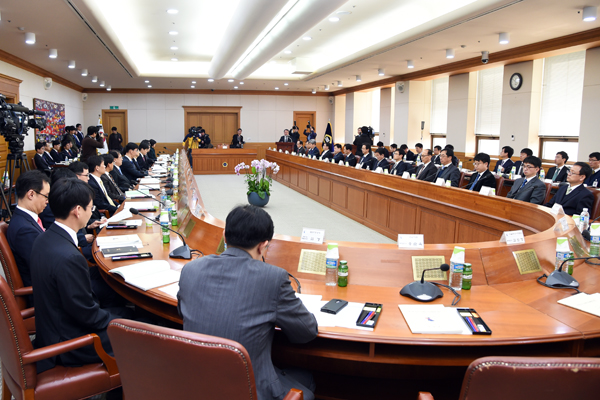
Conference of Presiding Judges in Exclusive Charge of Election Offenses was held in advance of the 20th Election of National Assembly Members scheduled on April 13, 2016, with the aims to conduct expeditious and exhaustive hearings and to deliver strict sentencing onto election offense cases.
To that extent, the participating judges set a common goal to “timely process cases within two months period,” and to deliver the appropriate severity of sentences through the efforts to “conduct court-driven and exhaustive sentencing hearings” and “impose rigorous sentences on serious election offences.”
1. Overview of the Conference
A. Conference Background
With great importance put on expeditious and exhaustive hearing process along with strict sentencing on election offense cases, Conference of Presiding Judges in Exclusive Charge of Election Offenses was held for the participating judges to discuss and devise the specific ways to achieve such important objectives, ultimately to establish fair and transparent election culture.
Against this backdrop, there had been ten Conferences held from 1994 to 2014, and this year’s Conference was organized prior to the 20th Election for National Assembly Members scheduled on April 13, 2016.
In the 11th Conference of Presiding Judges of Election Offenses, the participants made presentations and had discussions on the expeditious and exhaustive processing of trials related to the 20th Election for National Assembly Members, based on the analyses of election cases from the 19th Election for National Assembly Members held on April 11, 2012 and the 6th Election for Local Councils and Head of Local Governments held on June 4, 2014.
B. Date and Venue
● Date and Time: 10:00 – 17:00, Monday, March 21, 2016
● Venue: Grand Conference Room at the Supreme Court
C. Participants
● Participants from 5 high courts and extra-court trial panels; 18 district courts; and 40 branch courts
● Total 54 presiding judges in exclusive charge of election offenses from courts nationwide
2. Conference Topics
A. Expeditious and exhaustive management of election offense cases
B. Appropriate sentencing on election offense cases
3. Conference Outcome
The presiding judges for election offenses confirmed in agreement to make efforts to achieve the following objectives:
A. Conduct of expeditious and exhaustive hearings: “Two-month goal to timely process cases” and “schedule trials every day if feasible, to conduct focused evidence examinations”
● Establish a two-month period goal to finish processing each the first and second instance trials in particular for the election offense cases regarding the validity of the winner of the election. The two-month time goal is shorter than the period set forth in the law, leading to the expeditious processing of election trials.
- First instance: Two months from the date the indictment is filed
- Second instance: Two months from the date the trial record is filed
● Conduct exhaustive election trials on the validity of the election winner while meeting the time goal, by making efforts to: (1) implement the operation of the Focused Evidence Examination Team currently under pilot operation at Seoul Central District Court, borne with the task goals of early classification of election offense cases, thorough analysis of the disputed issue and comprehensive establishment of hearing plan; and (2) introduce focused evidence examination by holding the hearings every day if feasible.
B. Imposition of sentences with appropriate severity: “Court-driven and exhaustive sentencing hearings” and “rigorous sentencing on serious election offences”
● The participants concluded that while the panel’s sentencing on election offenses shall take consideration of the importance of benefits and protections of the laws in the spirit of free election and impartiality, severe sentences such as election invalidation shall be fully considered for grave offenses, including corrupt practices and inducement by interest with large amount of money or interest provided or received; violations of prohibition and restriction on contribution acts; slanders against candidates and publication of false facts in the intention of have the candidate not elected for the election; and violations of prohibition of false criticism or report.
● In consideration of the importance of sentence length and the public interest on such sentence severity as well as the decisions on guilty or acquittal, the participants agreed to make appropriate sentencing decision in first instance trials through exhaustive hearing in courtroom, based on the sentencing conditions prescribed in Article 51 of the Criminal Act and sentencing factors suggested by the sentencing guidelines; and in the appellate trials, the judges agreed to respect the first-instance judgment to the fullest extent, unless the discretion embodied in the sentencing decision is deemed to have exceeded the maximum acceptable rationality.
● In addition, the Conference reached a consensus to make multifaceted efforts to narrow the sentencing gaps in election offense cases that exist between different regions and courts, as the presiding judges of election offense cases actively engage in various information exchanges and sentencing discussions via online community networks such as the CourtNet.
|


